Buy family.co.at ?
We are moving the project
family.co.at .
Are you interested in purchasing the domain
family.co.at ?
domain@kv-gmbh.de · 0541-91531010
Buy family.co.at ?
Why does Lipschitz continuity automatically imply continuity?
Lipschitz continuity automatically implies continuity because Lipschitz continuity places a bound on the rate at which a function can change. This means that the function cannot have sudden, large changes in its values, and therefore it must be continuous. In other words, if a function is Lipschitz continuous, it is guaranteed to be continuous because it cannot have any abrupt jumps or discontinuities. This property makes Lipschitz continuity a stronger condition than just continuity. **
Is Continuity bugged?
Continuity is not bugged. It is a fundamental concept in mathematics and refers to the idea that a function or a curve can be drawn without lifting the pen from the paper. In the context of software development, continuity refers to the smooth and uninterrupted operation of a program or system. If there are issues with continuity in a software application, it is likely due to bugs or errors in the code, rather than a problem with the concept of continuity itself. **


Similar search terms for Continuity
Top-Angebote
Products related to Continuity:
-
Inspire Curations DM850 Digital Multimeter 1999 Count AC DC Voltage Tester With Ohm, Current & Continuity Measurement orangeGet accurate electrical readings with confidencewhether you're troubleshooting at home or working on professional repairs. This digital multimeter tester is designed for electricians, technicians, and DIY users who need reliable measurements in a...53,00 $*Shipping: 0,00 $Secure redirect to the provider
-
Scribe UK Extraordinary Parenting: The Essential Guide to Parenting and Educating at Home by Eloise Rickman - Paperback - Home Education & Parenting GuideA warm and practical companion for families choosing to learn together outside the classroom, this guide by Eloise Rickman offers reassurance, real strategies, and a rights-based approach to raising confident, independent children. Written by an experienced parenting coach, it moves past rigid timetables and worksheets, showing parents how genuine connection, secure routines, and a simplified home can spark curiosity naturally. Whether you're a full-time home educator or want more intentional learning in everyday life, this guide explores how everyday family life can become the richest classroom of all, drawing on the author's experience supporting home-educating families to explain how secure attachment underpins genuine curiosity and lifelong learning.5,49 £*Shipping: 2,99 £Secure redirect to the provider
-
Scribe UK Parenting from the Inside Out: how a deeper self-understanding can help you raise children who thrive (Mindful Parenting)An updated edition of the parenting classic Have you ever thought: ‘I can’t believe I just said to my child the very thing my parents used to say to me! Am I destined to repeat the mistakes of my parents?’ In Parenting from the Inside Out, child psychiatrist Daniel J. Siegel and early-childhood expert Mary Hartzell explore how our childhood experiences shape the way we parent. Drawing on stunning new findings in neurobiology and attachment research, they explain how interpersonal relationships affect the development of the brain, and offer a step-by-step approach to forming a deeper understanding of our life stories, which will help us raise compassionate and resilient children. Combining Siegel’s cutting-edge neuroscience research with Hartzell’s 30 years of experience as a child-development specialist and parent educator, Parenting from the Inside Out guides us through creating the necessary foundations for secure and loving relationships with our children. This tenth-anniversary edition includes a new preface by the authors and incorporates the latest research from the field.7,99 £*Shipping: 2,99 £Secure redirect to the provider
-
The Readers Paradise The Complete Parenting Guide: Positive Parenting by Prof. N. K. Chandha - Non Fiction Paperback - Practical Advice for Raising Confident, Happy ChildrenRaising confident, emotionally balanced children starts with the right guidance, and The Complete Parenting Guide: Positive Parenting delivers exactly that. Written by Prof. N. K. Chandha, this accessible non-fiction paperback moves beyond vague theory to offer practical, everyday strategies parents can use immediately. It focuses on communication, boundaries, and emotional wellbeing, giving mums and dads a steady reference to return to as their family grows and new challenges appear along the way. This guide is built around the principles of positive parenting: nurturing children through encouragement, consistency, and empathy rather than fear or punishment. Across its chapters, the book walks through the core pillars of raising a well-adjusted child, including building self-esteem, encouraging independence, and managing difficult behaviour calmly.2,99 £*Shipping: 2,99 £Secure redirect to the provider




-
What is personal continuity?
Personal continuity refers to the sense of identity and connectedness that individuals experience over time. It encompasses the feeling of being the same person despite changes in physical appearance, beliefs, and experiences. Personal continuity is often tied to the concept of self-identity and the ability to maintain a coherent sense of self across different stages of life. It can also involve the preservation of memories, values, and relationships that contribute to a person's sense of continuity and stability. **
-
What is the difference between pointwise continuity and uniform continuity in mathematics?
Pointwise continuity refers to the property of a function where it is continuous at each individual point in its domain. This means that for every point x in the domain, the function f(x) has a limit as x approaches that point. On the other hand, uniform continuity refers to the property of a function where the rate of change of the function is controlled by a single value for the entire domain. In other words, for any ε > 0, there exists a δ > 0 such that for all x and y in the domain, |x - y| < δ implies |f(x) - f(y)| < ε. In pointwise continuity, the choice of δ may depend on the specific point x, while in uniform continuity, the choice of δ must work for the entire domain simultaneously. **
-
What is the equivalence of the continuity concepts Epsilon-Delta and sequential continuity?
The equivalence of the continuity concepts Epsilon-Delta and sequential continuity lies in the fact that they both capture the idea of a function being continuous at a point. In the Epsilon-Delta definition, continuity is defined in terms of neighborhoods and limits, while in sequential continuity, it is defined in terms of sequences converging to a point. Both definitions ultimately aim to capture the intuitive notion of a function having no sudden jumps or breaks at a particular point. Despite the differences in their formal definitions, both concepts are equivalent and can be used interchangeably to prove continuity of a function. **
-
How can one disprove continuity?
One way to disprove continuity is to find a point where the function is not defined or where the limit of the function does not exist. Another way is to show that the function has a jump discontinuity, where the value of the function changes abruptly at a certain point. Additionally, one can disprove continuity by demonstrating that the function has an infinite discontinuity, such as a vertical asymptote where the function approaches infinity at a certain point. **

What is the continuity equation?
The continuity equation is a fundamental principle in fluid dynamics that states that the mass of a fluid entering a system must be equal to the mass of the fluid leaving the system, assuming there are no sources or sinks of mass within the system. Mathematically, it is expressed as the equation of continuity, which states that the product of the fluid density, velocity, and cross-sectional area must remain constant at any point along a flow. This equation is derived from the principle of conservation of mass and is essential for understanding and analyzing fluid flow in various engineering applications. **
Why does differentiability imply continuity?
Differentiability implies continuity because in order for a function to be differentiable at a point, it must be continuous at that point. This is because the definition of differentiability includes the existence of a derivative, which in turn requires the function to be continuous. If a function is not continuous at a point, it cannot have a derivative at that point, and therefore cannot be differentiable. Therefore, differentiability implies continuity. **
Top-Angebote
Products related to Continuity:
-
Inspired Deals Digital Voltage Tester And Socket Phase Meter With Continuity Test redTake the guesswork out of everyday electrical checks with a compact tool built for faster, more confident troubleshooting. This ANENG digital voltage tester combines socket testing, ACDC voltage detection, continuity checking, and liveneutral...49,97 $*Shipping: 0,00 $Secure redirect to the provider
-
Inspire Curations DM850 Digital Multimeter 1999 Count AC DC Voltage Tester With Ohm, Current & Continuity Measurement orangeGet accurate electrical readings with confidencewhether you're troubleshooting at home or working on professional repairs. This digital multimeter tester is designed for electricians, technicians, and DIY users who need reliable measurements in a...53,00 $*Shipping: 0,00 $Secure redirect to the provider
-
Scribe UK Extraordinary Parenting: The Essential Guide to Parenting and Educating at Home by Eloise Rickman - Paperback - Home Education & Parenting GuideA warm and practical companion for families choosing to learn together outside the classroom, this guide by Eloise Rickman offers reassurance, real strategies, and a rights-based approach to raising confident, independent children. Written by an experienced parenting coach, it moves past rigid timetables and worksheets, showing parents how genuine connection, secure routines, and a simplified home can spark curiosity naturally. Whether you're a full-time home educator or want more intentional learning in everyday life, this guide explores how everyday family life can become the richest classroom of all, drawing on the author's experience supporting home-educating families to explain how secure attachment underpins genuine curiosity and lifelong learning.5,49 £*Shipping: 2,99 £Secure redirect to the provider
-
Why does Lipschitz continuity automatically imply continuity?
Lipschitz continuity automatically implies continuity because Lipschitz continuity places a bound on the rate at which a function can change. This means that the function cannot have sudden, large changes in its values, and therefore it must be continuous. In other words, if a function is Lipschitz continuous, it is guaranteed to be continuous because it cannot have any abrupt jumps or discontinuities. This property makes Lipschitz continuity a stronger condition than just continuity. **
-
Is Continuity bugged?
Continuity is not bugged. It is a fundamental concept in mathematics and refers to the idea that a function or a curve can be drawn without lifting the pen from the paper. In the context of software development, continuity refers to the smooth and uninterrupted operation of a program or system. If there are issues with continuity in a software application, it is likely due to bugs or errors in the code, rather than a problem with the concept of continuity itself. **
-
What is personal continuity?
Personal continuity refers to the sense of identity and connectedness that individuals experience over time. It encompasses the feeling of being the same person despite changes in physical appearance, beliefs, and experiences. Personal continuity is often tied to the concept of self-identity and the ability to maintain a coherent sense of self across different stages of life. It can also involve the preservation of memories, values, and relationships that contribute to a person's sense of continuity and stability. **
-
What is the difference between pointwise continuity and uniform continuity in mathematics?
Pointwise continuity refers to the property of a function where it is continuous at each individual point in its domain. This means that for every point x in the domain, the function f(x) has a limit as x approaches that point. On the other hand, uniform continuity refers to the property of a function where the rate of change of the function is controlled by a single value for the entire domain. In other words, for any ε > 0, there exists a δ > 0 such that for all x and y in the domain, |x - y| < δ implies |f(x) - f(y)| < ε. In pointwise continuity, the choice of δ may depend on the specific point x, while in uniform continuity, the choice of δ must work for the entire domain simultaneously. **
Similar search terms for Continuity
-
Scribe UK Parenting from the Inside Out: how a deeper self-understanding can help you raise children who thrive (Mindful Parenting)An updated edition of the parenting classic Have you ever thought: ‘I can’t believe I just said to my child the very thing my parents used to say to me! Am I destined to repeat the mistakes of my parents?’ In Parenting from the Inside Out, child psychiatrist Daniel J. Siegel and early-childhood expert Mary Hartzell explore how our childhood experiences shape the way we parent. Drawing on stunning new findings in neurobiology and attachment research, they explain how interpersonal relationships affect the development of the brain, and offer a step-by-step approach to forming a deeper understanding of our life stories, which will help us raise compassionate and resilient children. Combining Siegel’s cutting-edge neuroscience research with Hartzell’s 30 years of experience as a child-development specialist and parent educator, Parenting from the Inside Out guides us through creating the necessary foundations for secure and loving relationships with our children. This tenth-anniversary edition includes a new preface by the authors and incorporates the latest research from the field.7,99 £*Shipping: 2,99 £Secure redirect to the provider
-
The Readers Paradise The Complete Parenting Guide: Positive Parenting by Prof. N. K. Chandha - Non Fiction Paperback - Practical Advice for Raising Confident, Happy ChildrenRaising confident, emotionally balanced children starts with the right guidance, and The Complete Parenting Guide: Positive Parenting delivers exactly that. Written by Prof. N. K. Chandha, this accessible non-fiction paperback moves beyond vague theory to offer practical, everyday strategies parents can use immediately. It focuses on communication, boundaries, and emotional wellbeing, giving mums and dads a steady reference to return to as their family grows and new challenges appear along the way. This guide is built around the principles of positive parenting: nurturing children through encouragement, consistency, and empathy rather than fear or punishment. Across its chapters, the book walks through the core pillars of raising a well-adjusted child, including building self-esteem, encouraging independence, and managing difficult behaviour calmly.2,99 £*Shipping: 2,99 £Secure redirect to the provider
-
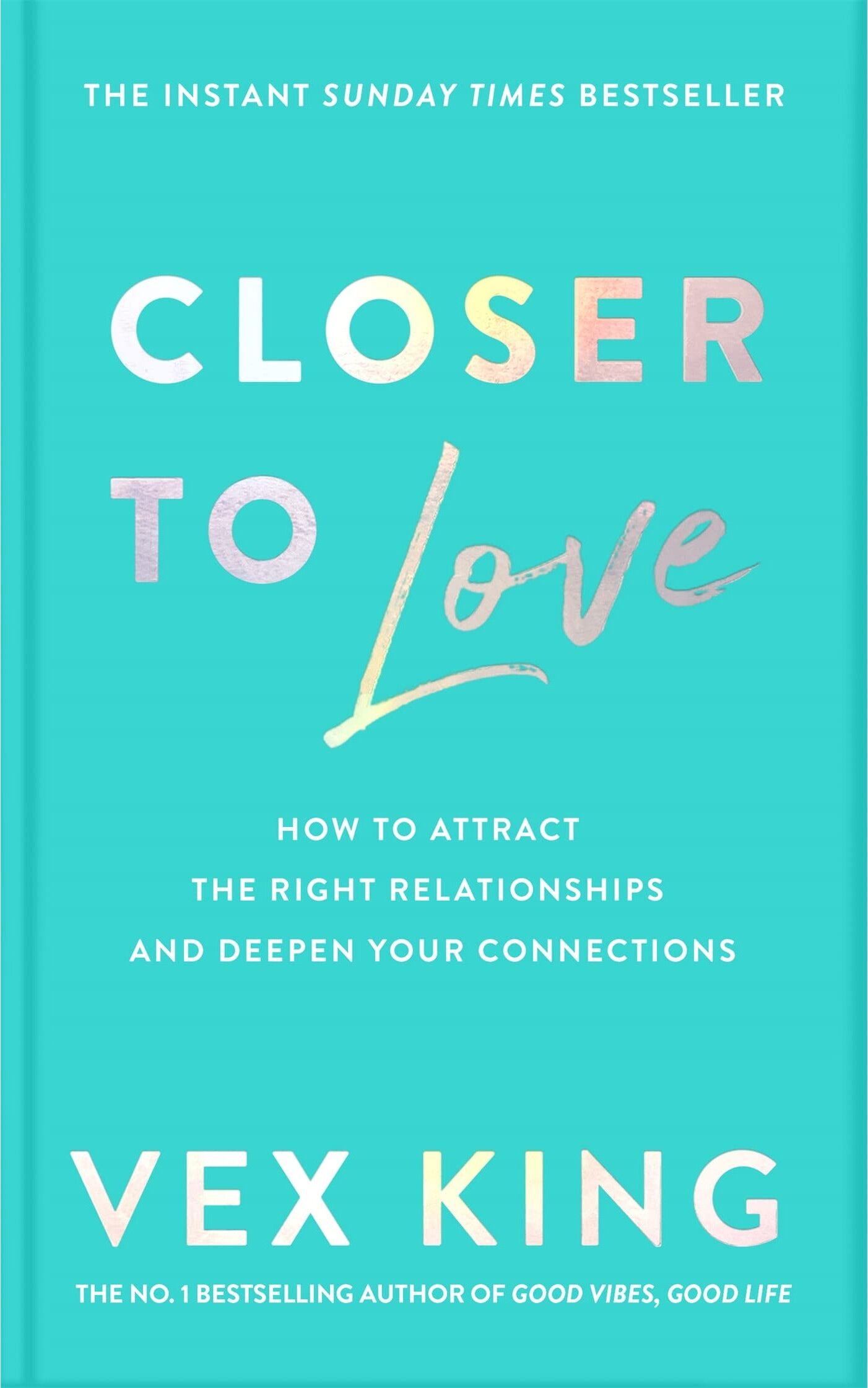
Bluebird Closer to Love: How to Attract the Right Relationships and Deepen Your Connections by Vex King - PAPERBACKDo you love your partner but want to rekindle that ‘in love’ feeling?Do you go on plenty of dates but can’t seem to click with the right person?Do you keep having the same conflicts with your partner?Embark on a journey of self-love to experience authentic connection and unconditional love . . .Speaking from his personal experiences of healing from heartbreak and finding lasting love, Vex shares practical advice and thought-provoking insights to help you:- Understand how you love and the role you play in your connections- Heal from past conditioning, unprocessed emotions and trauma- Cultivate healthy habits, boundaries and behaviours- Nurture meaningful, mindful and lasting connections.Essential reading for anyone looking to deepen their understanding of themselves and their relationships.7,99 £*Shipping: 2,99 £Secure redirect to the provider
-
Mastering Relationships by Astha Kapoor - Relationship & Self-Help Guide - New Paperback - Practical Advice for Healthier RelationshipsRelationships shape almost every part of our daily happiness, yet so many of us never learn the practical skills needed to keep them strong. Mastering Relationships by Astha Kapoor is a down-to-earth non-fiction guide that tackles communication, boundaries, and emotional connection head-on. Rather than leaning on dense psychological jargon, the author offers clear, usable advice for anyone wanting calmer conversations, deeper trust, and fewer repeated arguments. This paperback is written for real life, not theory, making it a genuinely approachable read for partners, friends, and families alike. Mastering Relationships walks readers through the everyday friction points that quietly erode connection: miscommunication, unspoken expectations, and boundaries that are either too rigid or missing altogether. Astha Kapoor breaks these challenges into manageable, relatable chapters, encouraging self-reflection.2,99 £*Shipping: 2,99 £Secure redirect to the provider
-
What is the equivalence of the continuity concepts Epsilon-Delta and sequential continuity?
The equivalence of the continuity concepts Epsilon-Delta and sequential continuity lies in the fact that they both capture the idea of a function being continuous at a point. In the Epsilon-Delta definition, continuity is defined in terms of neighborhoods and limits, while in sequential continuity, it is defined in terms of sequences converging to a point. Both definitions ultimately aim to capture the intuitive notion of a function having no sudden jumps or breaks at a particular point. Despite the differences in their formal definitions, both concepts are equivalent and can be used interchangeably to prove continuity of a function. **
-
How can one disprove continuity?
One way to disprove continuity is to find a point where the function is not defined or where the limit of the function does not exist. Another way is to show that the function has a jump discontinuity, where the value of the function changes abruptly at a certain point. Additionally, one can disprove continuity by demonstrating that the function has an infinite discontinuity, such as a vertical asymptote where the function approaches infinity at a certain point. **
-
What is the continuity equation?
The continuity equation is a fundamental principle in fluid dynamics that states that the mass of a fluid entering a system must be equal to the mass of the fluid leaving the system, assuming there are no sources or sinks of mass within the system. Mathematically, it is expressed as the equation of continuity, which states that the product of the fluid density, velocity, and cross-sectional area must remain constant at any point along a flow. This equation is derived from the principle of conservation of mass and is essential for understanding and analyzing fluid flow in various engineering applications. **
-
Why does differentiability imply continuity?
Differentiability implies continuity because in order for a function to be differentiable at a point, it must be continuous at that point. This is because the definition of differentiability includes the existence of a derivative, which in turn requires the function to be continuous. If a function is not continuous at a point, it cannot have a derivative at that point, and therefore cannot be differentiable. Therefore, differentiability implies continuity. **
* All prices are inclusive of VAT and, if applicable, plus shipping costs. The offer information is based on the details provided by the respective shop and is updated through automated processes. Real-time updates do not occur, so deviations can occur in individual cases. ** Note: Parts of this content were created by AI.